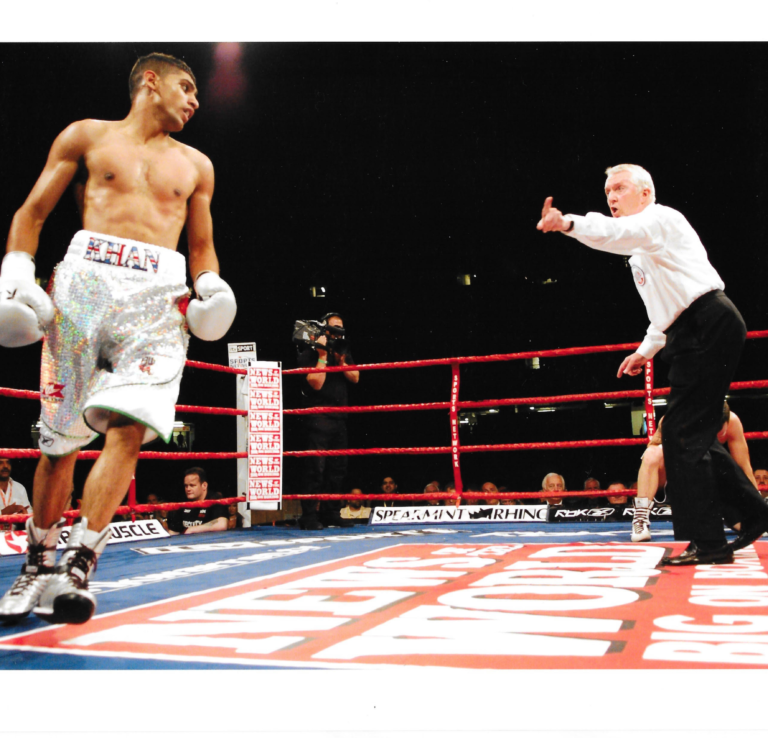
Boxing is seen by some as the purest form of sport. Two athletes competing against each other with their fists. The boxers are effectively skilled in violence and their primary aim is to render their opponent unconscious. The brutal nature of the sport means that fighter-safety is paramount. Key to that safety is the conduct and intervention of the referee.
Retired boxing referee Wynford Jones knows that more than most, as he took charge of 517 bouts during a career spanning over three and a half decades. That career came after years of interest in the sport as a fan and has been followed by a role within the British Boxing Board of Control as a steward. Although he stepped into the squared circle with some dangerous men, Jones said “I have never been intimidated in the ring, I have always been entirely comfortable, whenever I stepped through those ropes I felt at home.”
He made the ring his home 517 times, but it must be noted that this total would have been much higher had Jones operated in a busier region. Wales has seen a number of major contests take place on its shores, but the frequency of professional bouts is far lower than that of Birmingham or London for example.
Jones’ refereeing principles
The Welshman took to officiating boxing contests as a way to be involved in his beloved sport. He had considered being a manager but due to his lack of in-ring experience, he felt that he would not gain the fighter’s respect. Perhaps that would have proved true, but he certainly earned his respect as an official.
This respect was earned through his high-quality decision making inside the ring and the moral codes and integrity he possessed. Boxing is a sport that is regularly accused of corruption and biased decisions. But as boxers, trainers and managers in Wales would say, whenever Jones was in charge of a contest the boxers knew they would get a fair deal.
That belief stemmed from Jones’s willingness to call a fight fairly and raise the hand of the away fighter if he deserved victory.
“Healthwise one punch can be too late, as you know, one punch can be one punch too many. Being the one closest to the action you have got to be there to make that call if and when it arises.
“Boxers are very proud people; they don’t know the meaning of the word quit and sometimes they have to be protected from themselves. The worst thing you can do as a referee I think is to be in there and thinking ‘God I’m enjoying this’, because if you have that thought going through your head you don’t belong in there.
“I found that I got satisfaction afterwards, driving home in the car or sitting there with a cup of tea at home thinking ‘hmmm ok I did a decent job tonight’ and then you can go to sleep. As a referee if you have got any baggage going on in your mind, any outside distractions in your mind, you really don’t belong in there.
“It’s one of those places where your entire focus must be on those two guys you have got in front of you, whether they are four round fighters or whether they are champions.”
How it started
Jones’s journey as a referee started in 1972 but he recalled his interest first being ignited years prior at a small hall show in south Wales.
“I can remember going to one of Eddie’s (Thomas) shows at the indoor cricket school in Ebbw Vale and there was a famous Welsh referee called Ike Powell, he was a star referee. He was a brilliant referee and he also did a weekly column for the Daily Express at the time.
“That night he wasn’t working, and I sat next to him, and at the end of every round he would pull a little card out of his pocket and I could see it now. ‘Ike Powell - Daily Express’ in a little bubble at the top of the card.
“He would write the scores down for that round and the mystique of that sort of appealed. So, when I was coming to the end of my university course I thought ‘I’m going to do something about this’, so I set out to become a referee.”
Once jones had made the decision to start the process of becoming a referee he never looked back.
“I lived in Leeds at the time and that comes under what is known as the Central Area of the boxing board and their headquarters were in Manchester at the time and I had to go over to Manchester for an interview at Belle Vue, which at one time was a famous boxing arena.
“They had a circus there and goodness knows what. I went there and I had an interview and there must have been about 20 of them sat around in a semi-circle. Ok, as someone who had been to university you are used to the interview situation, but I had never experienced anything quite like that.
“It was quite nerve racking because the questions just kept coming at me, coming at me and coming at me and at the end they just said ‘Well Mr Jones you obviously know your boxing so we’ll give you an opportunity to start the scoring tests.”
From there Jones started his scoring tests and in 1975 he moved back down to south Wales. He conducted some more scoring tests under the Welsh Area Council and in November of 1976 it was time to officiate his first bout.
“It was an 8 round contest which I had to stop in the sixth round. And Good for me, the referee who was actually scoring the fight had it exactly as I had it and it was regarded as the perfect stoppage.
“So, I got my license then by February of 1977. From Being licensed in 1977 I have been involved ever since.”
The retired referee said his refereeing license was his most valued possession. How much does your officiating career mean to you?